
Do I Need an eTA? Understanding Electronic Travel Authorization
Not sure whether you need a Canadian eTA before you fly? This practical guide explains who needs one, who does not, how to apply correctly, and the mistakes that can derail a trip.
Why this matters before you book a flight
A surprising number of trips go wrong before the traveler even reaches the airport gate. Not because of weather, baggage, or a cancelled booking, but because the passenger assumed a passport alone was enough. For many people flying to Canada, it is not. If you are from a visa-exempt country, you may also need an Electronic Travel Authorization, or eTA, before boarding your flight.
That detail matters more than it seems. Airlines check whether the required travel authorization is linked to your passport before they let you board. If you need an eTA and do not have one, you can be stopped at check-in even if your hotel is booked, your itinerary is set, and your suitcase is packed. A missed flight can quickly turn into lost reservations, extra fees, and a stressful scramble for answers.
The confusion usually comes from one simple problem: travelers mix up eTAs, visas, and eVisas as if they were interchangeable. They are not. Canada’s eTA is a specific pre-travel authorization for certain travelers, and whether you need it depends on your passport, how you are entering Canada, and sometimes your current status.
This guide is built to answer the practical question behind all the jargon: Do I need an eTA for Canada? You will get a clear explanation of who typically needs one, when it applies to air travel only, how to apply, where people get caught out, and what to check before departure.
> Quick takeaway: if you are flying to Canada and you are from a visa-exempt country, checking your eTA requirement should be one of your first planning steps, not your last.
What an eTA is, and what it is not
An Electronic Travel Authorization is a digital entry requirement used by Canada for many visa-exempt foreign nationals who travel to Canada by air. It is electronically linked to the passport used in the application. According to the Government of Canada, visa-exempt travellers generally need an eTA to fly to or transit through a Canadian airport, while different rules can apply for land or sea entry.
That digital setup is why the process often feels lightweight. There is usually no visa sticker in the passport and no separate physical document to attach to your booking. But “digital” does not mean “optional.” It is still a formal travel requirement when your case falls within the rules.
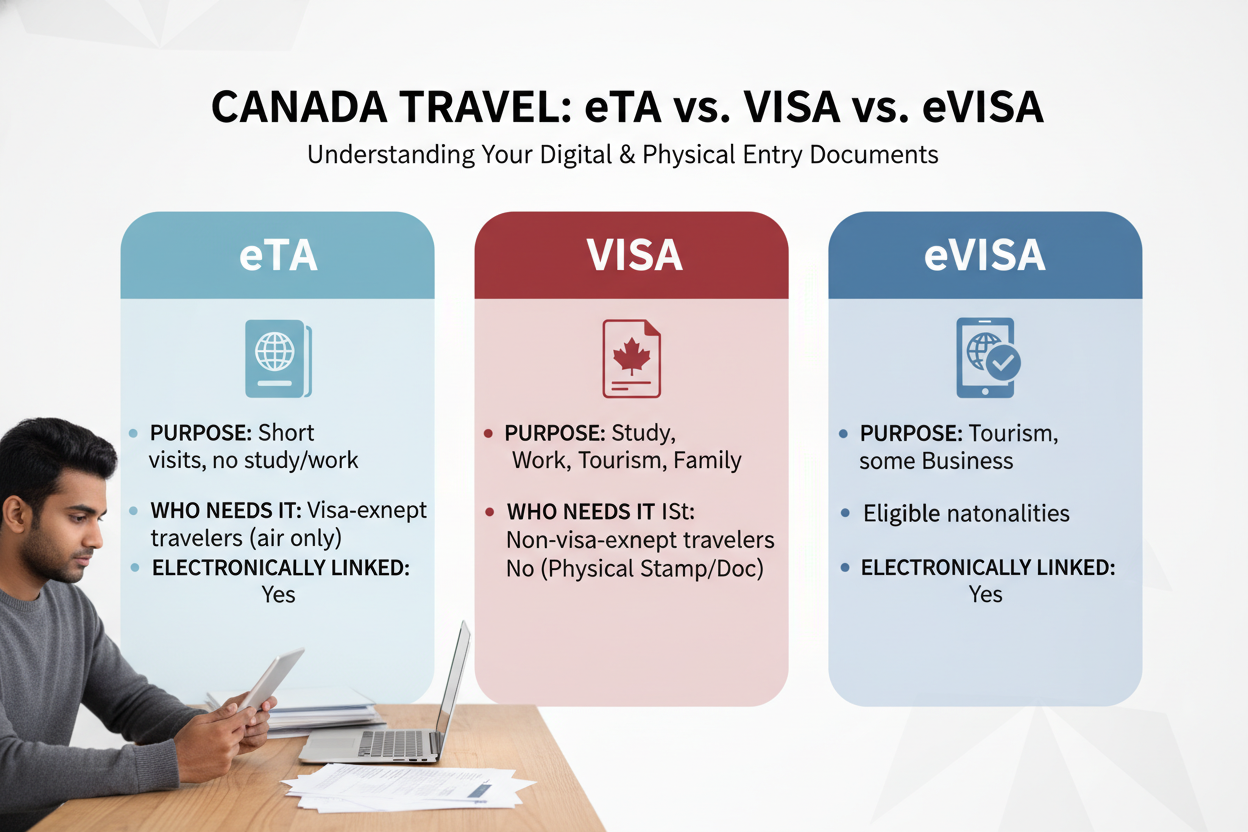
eTA vs visa vs eVisa
Many travelers search for all three terms at once, so here is the clean distinction.
| Document | What it usually means | Who it usually applies to | Key point |
|---|---|---|---|
| eTA | Pre-travel authorization | Visa-exempt travellers | Not a visa; tied to your passport |
| Visa | Formal permission to seek entry | Travellers from visa-required countries | Often involves a fuller assessment |
| eVisa | A visa issued electronically | Depends on the destination country | Still a visa, just digital |
An eTA is best understood as a screening requirement for eligible travelers, not a substitute for every other immigration document. If your nationality requires a visa for Canada, an eTA is not the workaround.
Why the distinction matters in real travel planning
People usually run into trouble when they assume a simpler term means a simpler rule. For example:
- a traveler hears that Canada has an “online travel document” and assumes everyone can use it
- someone with a visa-required passport applies for the wrong thing
- a dual national applies with one passport and travels with another
- a student or worker assumes visitor-style authorization covers every type of stay
A better approach is to treat the eTA as one piece of a larger travel-document check. It answers a specific question: are you a visa-exempt traveler flying to Canada who needs digital pre-approval linked to your passport?
> Takeaway: an eTA is not a “mini visa.” It is its own requirement with its own rules.
Who usually needs an eTA for Canada
The most useful starting point comes directly from Canada’s official guidance: visa-exempt foreign nationals generally need an eTA to fly to or transit through a Canadian airport. That is the rule most travelers should remember first. The keyword is “generally,” because eligibility and exceptions still matter.
In practice, whether you need an eTA depends on a small set of variables that work together, not separately.
The four checks that matter most
Before you apply, ask yourself:
- What passport will I use to travel?
- Am I entering Canada by air, land, or sea?
- Am I visa-exempt or visa-required for Canada?
- Am I visiting, transiting, or travelling under another status?
Common examples
Here are simple scenarios that help make the rule concrete.
- Holiday trip by air: A visa-exempt traveler flying to Toronto for tourism will generally need an eTA.
- Business meeting by air: A visa-exempt traveler attending short meetings in Canada will generally need an eTA to board the flight.
- Airport transit: A visa-exempt traveler connecting through a Canadian airport will generally need an eTA.
- Road crossing from the United States: That same traveler entering by land would generally not need an eTA, though they still need proper travel documents.
What the official university guidance adds for students
Western University’s student services guidance reinforces an important point for international students and temporary residents: travel document rules can affect whether you are able to board a return flight to Canada, especially after a trip abroad. That makes eTA awareness especially important for students who assume their study plans alone settle their travel eligibility.
For student readers, this is where confusion often starts. Your study permit, visitor status, and air-travel requirement are not the same thing. Depending on your nationality and status, the eTA question may still be relevant when you fly back to Canada.
A fast self-check table
| Your situation | eTA likely relevant? |
|---|---|
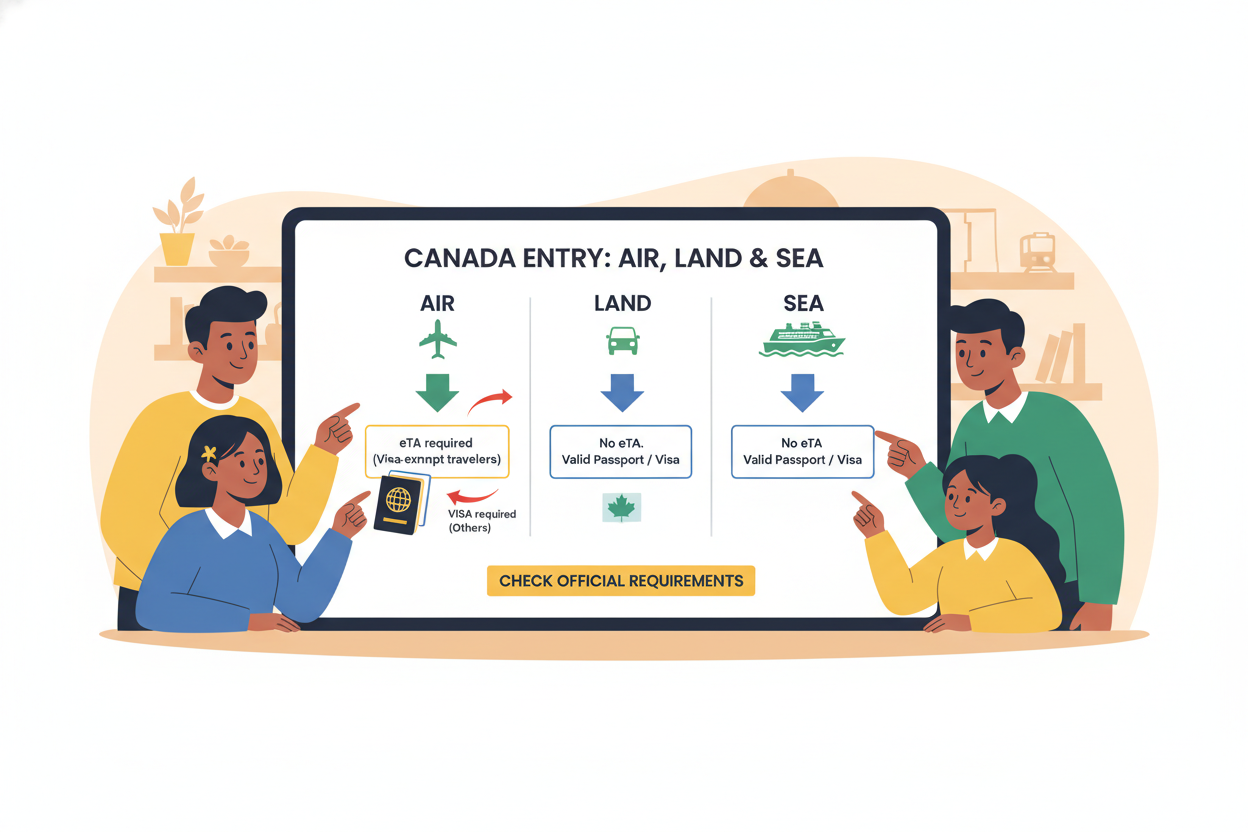
| Visa-exempt passport, flying to Canada | Yes, generally |
| Visa-exempt passport, transiting through Canada by air | Yes, generally |
| Visa-exempt passport, entering by land or sea | Usually no eTA required |
| Visa-required passport | Usually a visa issue, not an eTA issue |
> Takeaway: the quickest reliable filter is passport + travel mode. For Canada, air travel is the pivot point.
When you do not need an eTA, or need something else instead
Many readers ask the wrong first question: “How do I get an eTA?” The better first question is “Am I actually the kind of traveler who needs one?” That distinction can save you time, fees, and last-minute confusion.
The Government of Canada makes clear that not everyone needs an eTA. Some people do not need one because they are entering by land or sea. Others do not need one because they are not eligible for eTA travel in the first place and instead need a visa or another document.
Cases where an eTA may not be required
These are the most common non-eTA scenarios:
- You are entering Canada by land or sea. If you are arriving by car, bus, train, or cruise, the eTA requirement that applies to air travel generally does not apply in the same way.
- You already need a visa, not an eTA. A visa-required nationality should not assume an eTA can replace the correct visa.
- You are relying on a specific immigration status or travel document. Some travelers fall under special rules, and those should always be checked directly against official guidance.
The land-versus-air trap
This is one of the biggest misunderstandings. A traveler may correctly hear that visa-exempt visitors do not need an eTA to enter Canada by land, then wrongly assume that means they also do not need one to fly. That is exactly where airport problems begin.
A simple illustration:
- Entering Canada from the U.S. by car: eTA generally not required
- Flying to Canada from abroad: eTA generally required for visa-exempt travelers
Students, workers, and returning residents should be extra careful
If you are an international student or temporary resident returning to Canada after travel, do not assume your permit is the only document that matters for boarding. The university guidance linked above exists for a reason: travelers often discover too late that airline boarding checks focus on travel authorization linked to the passport, not just the purpose of stay once in Canada.
A practical rule to avoid overcomplicating it
Instead of memorizing every exception, use this sequence:
1. Confirm whether your passport is visa-exempt for Canada.
2. Confirm whether you are travelling by air.
3. If yes to both, check whether an eTA applies to your exact status.
4. If no, verify whether you need a visa or another document instead.
> Takeaway: not needing an eTA does not automatically mean you are clear to travel. It may mean a different document is required.
How to apply correctly without causing your own delay
For travelers who do need an eTA, the application itself is usually straightforward. The risk is not usually complexity; it is carelessness. A wrong passport number, mismatched name, or inaccessible email address can turn a simple task into a stressful one.
What to prepare before you start
Have these basics ready first:
- the exact passport you will travel with
- a working email account you check regularly
- a valid payment method
- enough time to complete the form carefully without rushing
Step-by-step application approach
1. Use the official government application page only. Avoid unnecessary third-party services unless you fully understand what they are doing and charging.
2. Enter personal details exactly as shown on your passport. This includes full name, passport number, date of birth, and nationality.
3. Answer background questions honestly and completely. Inaccurate answers create bigger problems than slow processing.
4. Pay the fee and save the confirmation. Keep records in one place.
5. Monitor your email after submission. Some applications are processed quickly; others may require follow-up.
The errors that cause the most avoidable trouble
The most common mistakes are ordinary, not dramatic:
- transposing digits in the passport number
- using a nickname instead of the passport name
- submitting with an old passport, then travelling with a renewed one
- mistyping the email address
- waiting until the day before departure to apply
Match your documents across the whole journey
Your passport details should align across:
- your eTA application
- your airline booking
- your check-in record
- the passport you physically carry on travel day
A simple application checklist
- Read details from the passport, not from memory
- Use the same passport for the application and the flight
- Keep confirmation emails accessible
- Leave buffer time before travel
- Recheck details before pressing submit
What happens after you apply and before you board
Submitting the form is not the end of the process. It is the point where you should become more attentive, not less. Even when an eTA is approved quickly, you still need to confirm that everything matches and that nothing changed before departure.
According to Canada’s official guidance, many eTA applications are approved within minutes, but some can take longer if more review is needed. That means “usually quick” should never be translated into “safe to leave until the last minute.”
Possible outcomes after submission
After applying, you may experience one of several paths:
- fast approval
- a request for more information
- a delay while the application is reviewed
- a negative outcome requiring you to reassess your travel document options
What approval actually means
An approved eTA is linked electronically to your passport. That means there may be no visible travel label and no document to attach physically to the passport. Still, keeping the approval email is useful for your own records and for quick reference if you need to verify dates or details.
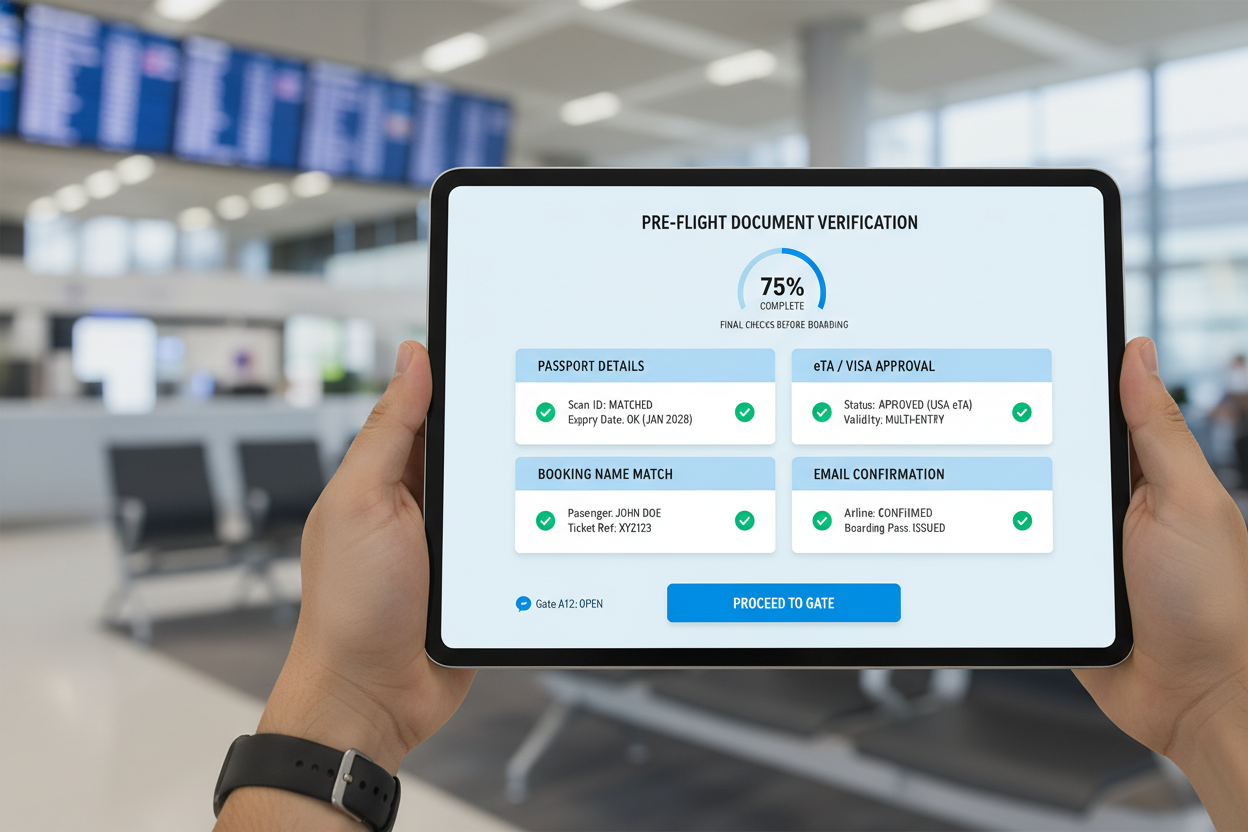
Your pre-flight verification routine
Before heading to the airport, confirm:
- the passport number on your authorization matches your current passport
- your passport has not changed since the application
- your flight booking matches your identity details
- you have access to your email or application confirmation
Remember what an eTA does not do
An eTA helps authorize travel to Canada by air when required. It does not guarantee admission at the border. Border officers still make the final decision when you arrive. That is why you should be prepared to answer basic questions about the purpose and length of your trip and to show the usual travel information if asked.
> Takeaway: approval is necessary for many travelers, but it is still only one checkpoint in the wider travel process.
What most travelers get wrong about eTAs
Here is the contrarian point: the biggest eTA risk is usually not government complexity. It is traveler overconfidence. People hear that the form is quick, the fee is small, or that approval often comes fast, and they mentally downgrade it from “immigration requirement” to “admin detail.” That is a mistake.
Mistake 1: treating old approval as permanent
An eTA is linked to the passport used in the application. If you renew or replace your passport, you should not assume the old authorization still solves the problem. This catches frequent travelers especially often because they remember applying once and forget the passport link is the real anchor.
Mistake 2: assuming transit does not count
Many people think, “I am not entering Canada, just changing planes.” For visa-exempt foreign nationals flying to or transiting through a Canadian airport, the eTA issue can still apply. Transit is exactly where some travelers are blindsided because they focus only on their final destination.
Mistake 3: confusing status in Canada with airline boarding eligibility
This matters for international students and workers. Having a study or work-related purpose does not automatically answer the airline’s document check. Your ability to remain in Canada under one set of rules and your ability to board a plane to Canada under another are related, but not identical.
Mistake 4: relying on copied advice
Travel forums, social media comments, and even well-meaning friends often leave out the details that change the answer:
- different nationality
- different passport
- different route
- different mode of entry
- different current status
> Takeaway: the dangerous assumption is not “I forgot to apply.” It is “my situation is probably the same as someone else’s.”
A practical action plan for travelers, students, and skilled workers
If you want a low-stress trip, the best strategy is to build a document check into your travel planning before you book anything expensive and non-refundable. That is especially important for readers juggling immigration status, international study, or cross-border business travel.
A 7-step travel document workflow
1. Decide which passport you will travel on.
2. Check whether that passport is visa-exempt for Canada.
3. Confirm your mode of entry: air, land, or sea.
4. If flying and visa-exempt, verify whether an eTA applies to your case.
5. Apply early enough to handle any follow-up.
6. If your passport changes, recheck everything immediately.
7. Do a final document review 24 to 72 hours before departure.
Different traveler profiles, different priorities
For tourists and family visitors
Focus on basics: correct passport, correct authorization, and enough lead time before departure.
For international students
Check your return-to-Canada documents well before semester travel or holiday trips. Do not assume that because you were already in Canada once, the boarding requirement will sort itself out.
For skilled workers and business travelers
Build a repeatable process. Frequent travel increases the chance of small mistakes because trips are booked quickly and document checks get rushed.
A short pre-departure checklist
- Is this the same passport used in my application?
- Am I entering by air, and does that change my requirement?
- Have I checked my email for any follow-up or approval notices?
- Did I renew my passport since my last authorization?
- If I am transiting, have I checked the transit rule too?
The best habit to adopt
Do not wait until online check-in opens to verify your travel authorization. By then, your choices are limited. The best time to check is when you first decide to travel, and the second-best time is now.
> Takeaway: a simple repeatable checklist prevents most eTA problems better than trying to memorize rules.
FAQ and conclusion: the simplest next step from here
FAQ
Do I need an eTA if I am only transiting through Canada?
Often yes, if you are a visa-exempt foreign national transiting through a Canadian airport by air. Check the official Canadian eligibility guidance for your passport and route.
Do I need an eTA if I enter Canada by car or bus?
Generally, visa-exempt travelers entering by land do not need an eTA, but they still need the proper travel documents.
Is an eTA the same as a visa?
No. An eTA is a travel authorization for eligible visa-exempt travelers. A visa is a different document with different rules.
What if I got a new passport after receiving an eTA?
You should recheck your status immediately, because the eTA is linked to the passport used in the application.
Conclusion
If you are asking whether you need an eTA, the smartest move is not to guess and not to rely on secondhand advice. Start with the official Canadian eligibility page, then match the answer to your exact situation: your passport, your route, your travel mode, and your current status.
For most visa-exempt travelers flying to Canada, the eTA is a small step with high consequences. It can be quick to sort out, but only if you check it early and enter your details correctly. For travelers entering by land or sea, or for people who actually need a visa instead, the right answer may be different.
Use these two official resources first:
- Government of Canada eTA eligibility: https://www.canada.ca/en/immigration-refugees-citizenship/services/visit-canada/eta/eligibility.html
- Western University eTA guidance: https://international.uwo.ca/studentservices/visas/electronic_travel_authorization_eta.html
Canada eTA
Ready to travel to Canada?
Apply for your Canada Electronic Travel Authorization online. Quick, guided, and approved in minutes.
Browse by topic